🔌 Select Home Appliances
Size Your Backup Hardware
Increase the quantities of your appliances on the left and click computing to view peak power loads, daily consumption units, battery sizes, and recommended solar setups.
Home › Load Calculator
Calculate your home's total peak power draw, daily units consumption, and backup specifications.
Increase the quantities of your appliances on the left and click computing to view peak power loads, daily consumption units, battery sizes, and recommended solar setups.
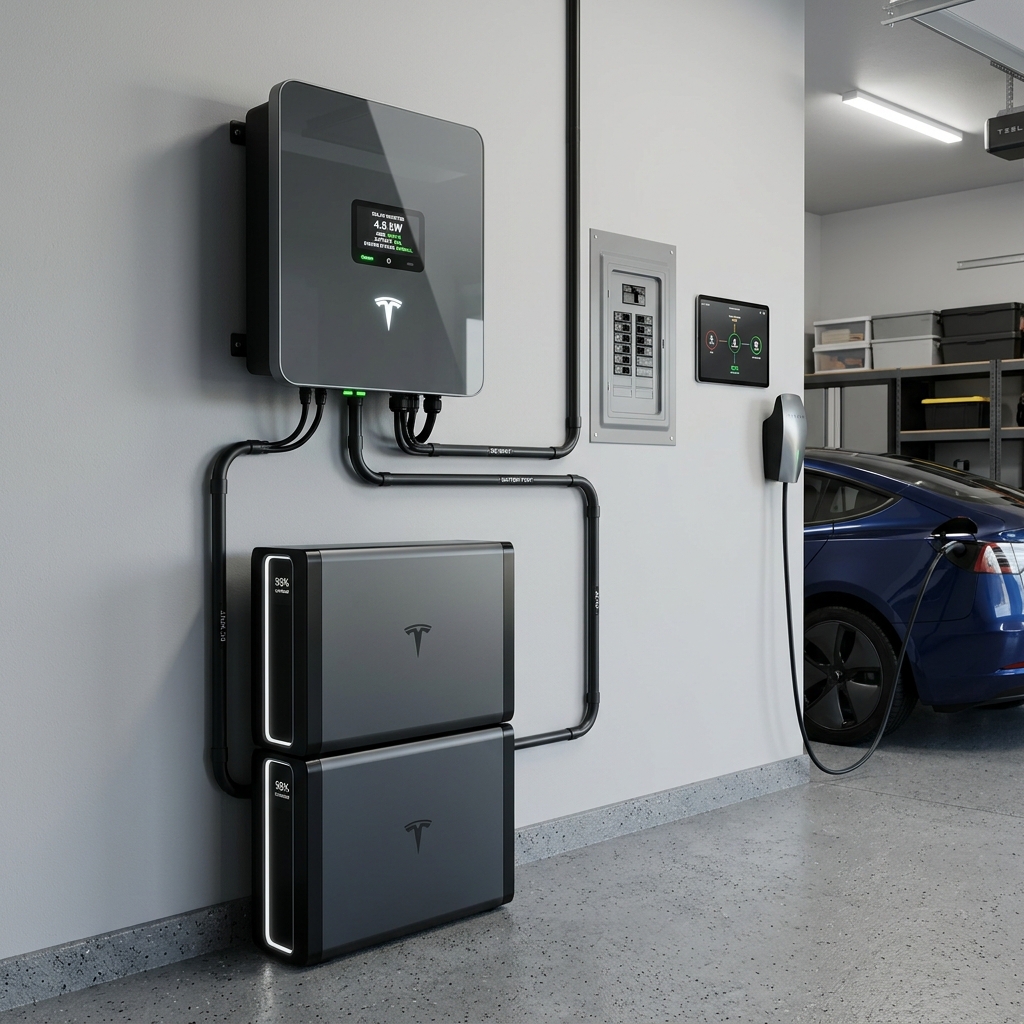
Choosing the right inverter and battery configuration is essential to keep your household running smoothly during power cuts. Without correct load sizing, your inverter may trip due to overload, or your batteries may drain too quickly, shortening their overall lifespan. This comprehensive guide walks you through the electrical math, appliance categories, and chemistry choices for backup power systems.
Appliance power specifications are usually written in Watts (W). However, inverters are rated in Volt-Amperes (VA). Watts represents the real energy consumed to perform work, while VA represents the apparent electrical power. They are related by the Power Factor (PF) of your appliances, which typically averages 0.8 for a standard home load. To find the correct inverter capacity, calculate your total peak running load in Watts, convert it to VA, and add a 25% safety buffer:
If your peak running load is 900 Watts, the math is: (900 ÷ 0.8) × 1.25 = 1406 VA. In this case, you should choose a standard 1500VA (1.5kVA) inverter. Standard inverter capacities available in the Indian market include 900VA, 1100VA, 1500VA, 2kVA, 3kVA, and 5kVA+.
While the inverter determines the maximum power load you can run at any given moment, the battery determines how long that load can run. Battery storage capacity is measured in Ampere-Hours (Ah). To calculate the required battery capacity, you need to identify the target backup duration (e.g. 4 hours) and choose a nominal DC system voltage (typically 12V for small inverters, 24V or 48V for larger systems):
Depth of Discharge (DoD) is a critical factor. For lead-acid batteries, discharging them below 50% significantly reduces their cycle life. Lithium batteries, however, can safely handle a 90% DoD. Assuming a 12V lead-acid battery running a 300W load for 4 hours with 85% inverter efficiency: (300 × 4) ÷ (12 × 0.50 × 0.85) = 235 Ah. You would need either two 120Ah batteries in parallel or a single large battery bank.
The electrical wave type determines how clean the output power is, affecting appliance lifespan and performance:
In 2026, smart solar hybrid inverters have become the default choice for modern homes. These systems monitor real-time grid electricity tariffs, solar generation, and battery status. They dynamically shift loads between solar, battery, and grid to minimize electricity bills while maintaining full emergency backup capacity.